Short answer. Mont-Saint-Michel has two parts. The village at the bottom, with its one long street, is free. The abbey at the top, with the church, the crypts and the Merveille, needs a ticket. Do the village on the way up, the abbey at the top, and take your time on the way down.
Tickets, guided visits and day trips
Mont-Saint-Michel Abbey: Entry Ticket
4.6· 10,829 reviews
from €13
Book tickets and tours →What is it like to walk the Grande Rue?
You enter through the gate in the ramparts and the street starts to climb at once. The Grande Rue is the medieval lane of the village, narrow and steep, lined with old houses, small shops and restaurants. It is busy in summer, so go early or late. You do not need a ticket for any of it.
The old parish church of Saint Peter stands in the area of the first village, close to its cemetery.
Why walk the ramparts?
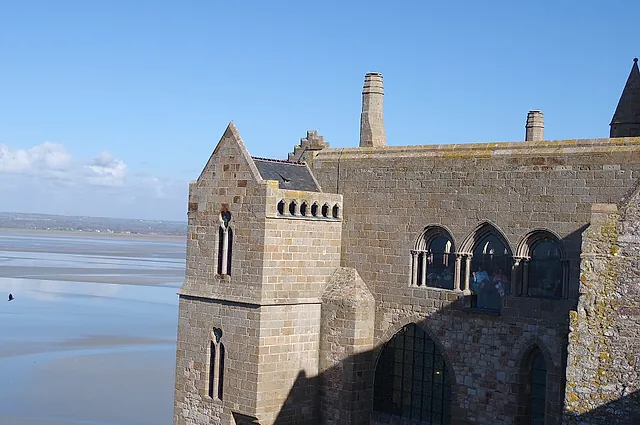
The walls are worth a walk because they give you the view. A large part of them was built by Abbot Robert Jollivet, and in 1417 he had the lower town surrounded by a wall with battlements. From the ramparts you look at the bay and the causeway. At low tide you see wide sandflats. At high tide you see water.
What is inside the abbey church?
The abbey church sits on the top of the rock, and the nave is the part that tells you how old it is. Work on it began in 1060, under Abbot Ranulf. In 1103 three bays collapsed, and they were rebuilt between 1115 and 1125. Inside you see the heavy stone of the Romanesque nave. The choir is different: it was rebuilt between 1446 and 1523 in the Flamboyant Gothic style.
Under the church there are crypts, among them the crypts of Saint-Martin and of the Thirty Candles, built between 1031 and 1047. One more detail is worth finding: Notre-Dame-Sous-Terre, a pre-Romanesque church that was found in 1898 by Paul Gout and was fully excavated in 1959.
What is the Merveille?
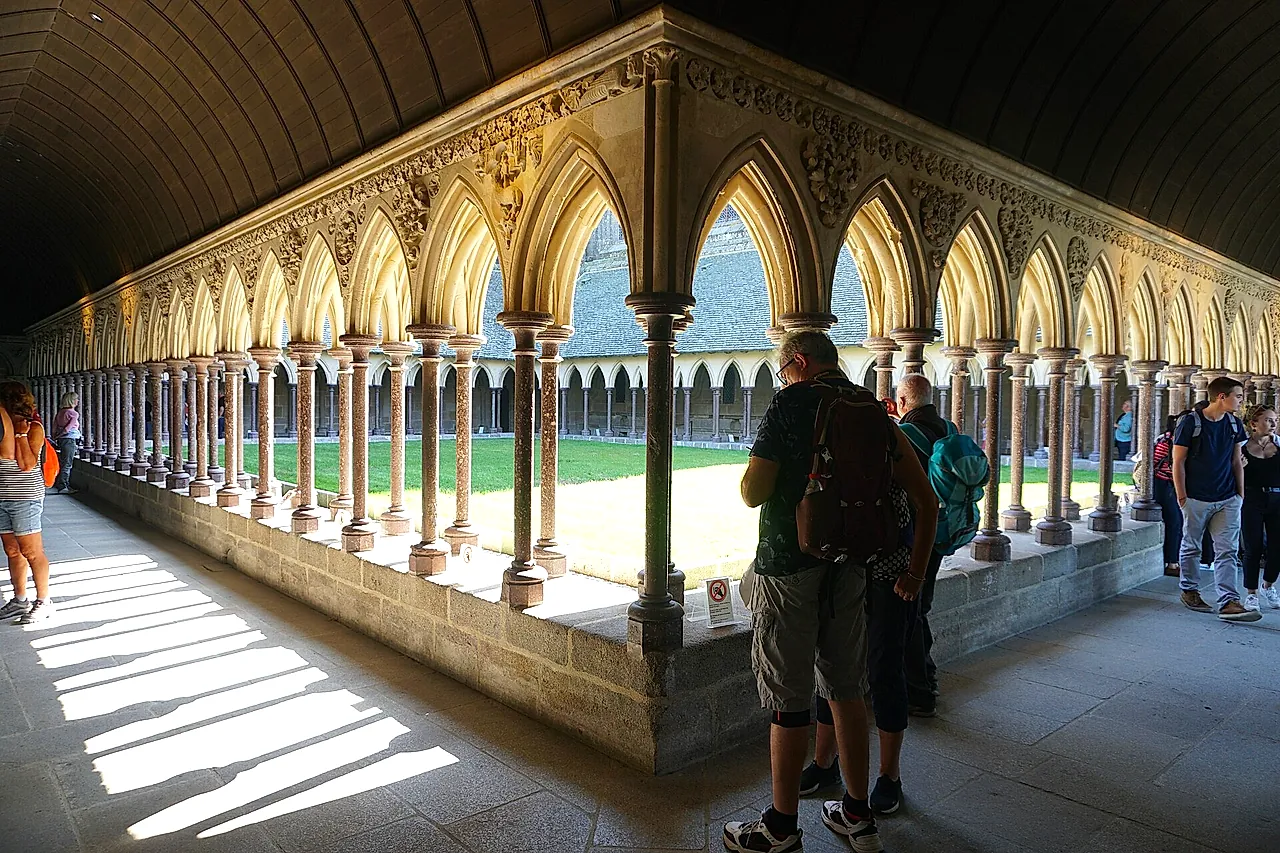
The Merveille is the Gothic part of the abbey, and its name means “the Marvel”. It was paid for by King Philip Augustus. The east side was built between 1211 and 1218, and the whole group was finished in 1228. Inside are the Knights’ Hall, built between 1220 and 1225, the refectory, from 1217 to 1220, and the cloister, from 1225 to 1228.
The route through the abbey goes from the crypts to the cloister, passing through the refectory. Wear good shoes: there are a lot of steps.
Who is the figure on top?
On the spire stands the archangel Michael, the saint of the Mont. The statue was made by the sculptor Emmanuel Frémiet, who began it in 1895 at the Monduit workshop and finished it in 1898. It is 4 metres tall. The neo-Gothic spire under it dates from 1896. With the statue, the top of the Mont reaches about 157 metres above the level of the shore.
Is there something beyond the Mont?
Yes, a small island called Tombelaine, a few kilometres to the north. It is a granite islet about 250 metres long and 150 wide, 45 metres high, and it has been a bird reserve since 1985. You reach it on foot with a guide at low tide, and not alone: walking in the bay without a guide is very dangerous. A priory was founded there in 1137.
How do I plan the visit?
Start at the village, walk up the Grande Rue, climb to the ramparts for the view, then enter the abbey. To book entry or a guided walk, see the tickets guide. To choose the right time of day, see hours, tides and getting there. If you like to know who built what, read the history of the Mont.
Which one for you?
Only an hour? Walk the Grande Rue and the ramparts. A morning? Add the abbey, from the church down to the cloister. A full day? Add a guided walk and some time on the bay, with a guide.